Marcus Mayorga, PhD — Behavioral Scientist & UX Researcher — Eugene, Oregon

Most research fails at the question, not the method.

I run large-scale experiments and choice models for consumer products — and I spend the first week of every study making sure the team is measuring the thing that actually matters. Sometimes that means telling a VP the study they asked for won't answer their question.

Selected work Four studies, one pattern
How I work Practice, not credentials

Check the raw data first

I wrote a short quality checklist for my team and it has three items: look closely at the raw data for abnormalities before running anything, verify your variable codings before a number leaves your hands, and if you can't explain the finding simply, the explanation is too complicated. Colleagues picked it up and kept using it.

Build rather than specify

I use AI coding agents to build my own research tooling: research assistants, code-checking safeguards on analysis pipelines, automation for the repetitive parts of a study. I share what I build. I prototype the same way. It is usually faster to make something real enough to test an idea against than to write a document arguing for it.

Use both halves of the toolkit

Moderated focus groups and think-aloud sessions on one side, choice models and mixed-effects experiments on the other. The qualitative work is usually what tells me the question is wrong. The quantitative work is what makes the answer hold up.

Lead with the picture

Reduce the text, show the chart, state the finding first. A result that a director can act on after one slide is worth more than a result that is technically complete and never read.

I'm a decision scientist who moved into industry research. For six years, I was a behavioral scientist, most recently senior, at a major online real estate marketplace, embedded with product and design teams on high-stakes consumer decisions. Before that, a decade in non-profit basic science psychology research, funded by the National Science Foundation, where I served as principal investigator.

  • PhD, Psychology (Decision Making) — University of Oregon, 2019
  • 25+ peer-reviewed publications · 1,000+ citations
  • Two papers in PNAS
  • R · experimental design · MaxDiff & conjoint · latent class analysis · mixed-effects models · survey methodology

Open to quantitative UX research, consumer insights, and research strategy roles.

These summaries are deliberately high-level. I'm glad to walk through the designs, effect sizes, and analysis in conversation.

Field experiment · thousands of participants · mixed-effects design

Everyone was refining the premise. I tested the premise.

The ask
Improve the automated messages within the existing design.
What I tested
Whether the design's central assumption held at all.

A major online real estate marketplace sent automated text messaging to consumers under a human identity. Every variant on the table treated that identity as a given and PMs asked how to refine it. Discovery pointed to a more valuable question underneath: whether the premise was right in the first place.

So I kept the incremental variants and added one that tested the assumption directly: a mixed-effects online experiment with thousands of homebuyers, powered to separate the effect of the premise from the effect of the wording.

Outcome

The study redirected the product to abandon the human identity rather than optimizing within it. The resulting approach shipped across both primary calls to action and remains in production. Effect sizes and business impact I'm glad to walk through in conversation.

Choice modeling · hundreds of real estate agents · anchored MaxDiff

A pricing study that became a roadmap.

The ask
Run a conjoint to price a new paid tier for agents.
What I ran
An anchored MaxDiff on feature priority — because the tier's contents weren't settled yet.

The request arrived as a pricing problem. Discovery interviews with the stakeholders surfaced the real open question underneath it: the team hadn't agreed on which capabilities belonged in a bundle, and pricing an undefined product would have produced a confident number about nothing.

I reframed the study with the VP who requested it, then fielded an anchored MaxDiff with hundreds of agents, anchored so the results distinguished features worth building from features merely preferred over worse ones.

Outcome

Set product and engineering priorities for the following year and surfaced a customer segment the original framing hadn't accounted for.

Segmentation · thousands of agents · latent class analysis

Rebuilt a segmentation so the categories were a finding, not an input.

The ask
Finish the stalled segmentation study using the planned k-means approach.
What I did
Rebuilt it as a latent class model, so the number of segments was an empirical result rather than an assumption.

I inherited a stalled study of several thousand agents with an analysis plan that couldn't support the decisions riding on it: k-means on mixed-type data, with cluster count effectively chosen in advance. I rebuilt it as a latent class analysis, which let the number of segments emerge from the data and gave each respondent a probability of membership instead of a hard label.

The results surfaced customer needs that didn't map cleanly onto the categories already in use. Delivering a finding like that well (so it lands as useful rather than as criticism) mattered as much as finding it.

Four agent segments arranged by business source and career stage Two segments sit on the referral-driven side of the map and two on the market-driven side; within each pair, one segment is established and one is still building. SPHERE-DRIVEN BUSINESS MARKET-DRIVEN BUSINESS ESTABLISHED ESTABLISHING Established referral network repeat and referral business Building a referral network turning new clients into repeat Listing-side specialists experienced, seller-focused Buyer-side newcomers early career, buyer-focused
Four segments, derived rather than assumed. The latent class solution separated agents on where their business comes from and how established that engine is, a structure the categories already in use did not reproduce. Segments are described generically here; class sizes, defining variables, and the working names are omitted.
Outcome

Informed multiple product strategies and annual planning, and replaced an assumed customer model with an empirically derived one.

Choice modeling · real estate agents · choice-based conjoint

Modeling a referral process encouraging significant behavior change.

The ask
Find out why agents send clients to their own lender instead of ours.
What I ran
A choice-based conjoint that modeled the tradeoffs behind a referral, rather than asking agents to narrate them.

The same marketplace also ran a home lending business, and it needed the agents on its platform to recommend that business to their clients. Most of those agents already had a local loan officer they had worked with for years: someone they trusted to close on time, and whose failure would land on the agent's own reputation rather than the lender's.

Asked directly, people give reasons for a referral that are tidier than the decision that produced it. So rather than ask, I put agents in the choice: repeated tradeoffs across lender attributes, designed so the part-worths could be estimated separately and recombined to simulate offers that didn't exist yet.

Price to the client strongest driver, by a wide margin
Local presence in-market vs. remote
Relationship continuity a consistent point of contact
Availability when the lender can be reached
Responsiveness speed of the first reply
What the conjoint put on the table. One price attribute and four service attributes, varied together so each one's contribution could be separated from the others. Price dominated: agents optimize first for what the deal costs their client, and everything else was secondary. But the service attributes are the ones a lender can actually change, which is where the design earned its keep. Attributes are described generically here and part-worths omitted.
Outcome

The findings were referenced in strategy discussion at the most senior level of the company. I'm glad to walk through attributes, utilities, and the products that used this information.

Background

A decision scientist who moved into industry research.

For six years, I was a behavioral scientist, most recently senior, at a major online real estate marketplace, embedded with product and design teams on high-stakes consumer decisions.

Before that, I spent a decade in non-profit basic science psychology research, studying risk perception, charitable donations, judgment, and how people respond to information under uncertainty, work funded by the National Science Foundation, where I served as principal investigator.

I work in experimental design and causal inference, choice modeling, segmentation, and survey methodology, mostly in R. I'm equally comfortable running the qualitative discovery that determines whether the quantitative study is worth fielding: moderated focus groups, think-aloud sessions, and stakeholder interviews.

Marcus Mayorga
  • PhD, Psychology (Decision Making) — University of Oregon, 2019
  • 25+ peer-reviewed publications · 1,000+ citations
  • Two papers in PNAS
  • Former NSF principal investigator
  • R · experimental design · MaxDiff & conjoint · latent class analysis · mixed-effects models · survey methodology
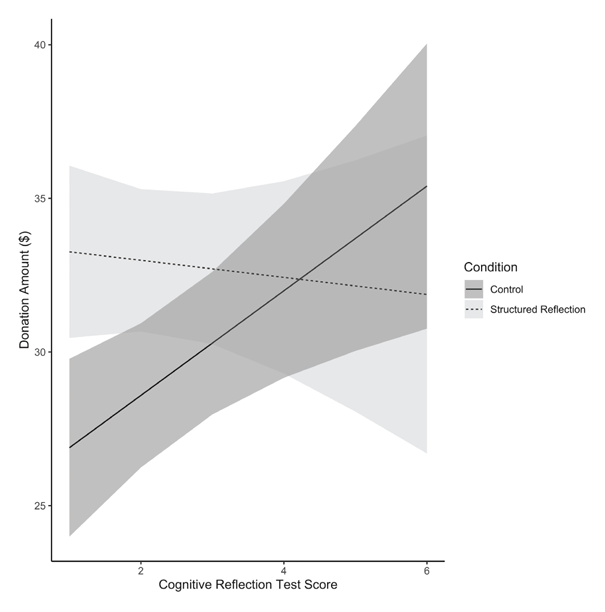
Line plot of donation amount against cognitive reflection test score. In the control condition, donations rise steeply with cognitive reflection score. In the structured reflection condition, donations are high and flat across all scores. Shaded bands show 95% confidence intervals.
From published work. A brief reflection prompt raised charitable giving most among people least inclined to deliberate on their own, flattening a gap that appears without it.
Reproduced from Ramos et al. (2022), “Structured reflection increases intentions to reduce other people’s health risks during COVID-19,” PNAS Nexus 1(5), pgac218, under CC BY 4.0. Read the paper